
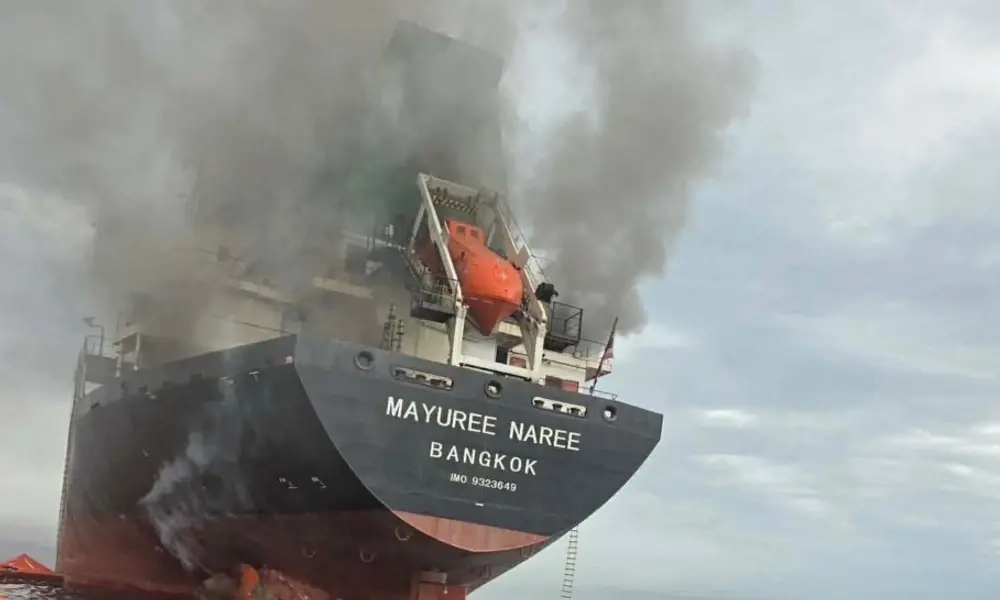
Thai Cargo Ship Mayuree Naree Bangkok Attacked in Strait of Hormuz
Table of Contents
- Thai Cargo Ship Attacked in Strait of Hormuz
- Details of the Incident
- Other Ships Also Targeted
- Strategic Importance of the Strait of Hormuz
- Maritime Security Concerns Rising
- Impact on Global Shipping and Energy Markets
Thai Cargo Ship Mayuree Naree Bangkok Attacked in Strait of Hormuz
A Strait of Hormuz attack involving a Thai cargo vessel has raised serious concerns about maritime security in one of the world’s most critical shipping corridors. The cargo ship Mayuree Naree Bangkok, flying the Thai flag and operated by Precious Shipping, caught fire after being struck by an unidentified projectile while passing through the Strait of Hormuz.
According to reports from the United Kingdom Maritime Trade Operations (UKMTO), the vessel was hit by a ballistic-style projectile, triggering a fire onboard. The incident occurred approximately 11 nautical miles north of Oman, an area that forms part of the highly strategic Strait of Hormuz.
The Strait of Hormuz attack has once again highlighted growing geopolitical tensions in the region and the risks faced by commercial vessels traveling through one of the most important maritime trade routes in the world.
Details of the Incident
The UKMTO, which operates under the British military to monitor maritime threats, confirmed that the ship’s crew reported being struck by an unknown object that caused a fire onboard.
Following the impact, the Mayuree Naree Bangkok immediately sent a distress signal requesting emergency assistance. Crew members began evacuation procedures as flames spread on the vessel.
Images released by maritime news outlet Splash 247 show visible damage and smoke coming from the ship after the attack. Fortunately, after several hours, the fire was successfully brought under control.
Initial reports suggest that all crew members managed to evacuate safely from the vessel during the Strait of Hormuz attack.
Other Ships Also Targeted
The Strait of Hormuz attack was not an isolated incident. Several other vessels operating in nearby waters reported damage from similar attacks on the same day.
One of the affected ships was the ONE Majesty, a Japanese-flagged container vessel with a capacity of 6,724 TEU. The captain reported that the ship suffered structural damage after being struck, leaving a 10-centimeter hole in the hull.
Despite the damage, the vessel was able to navigate to a safe anchorage. Authorities confirmed that all crew members aboard the ONE Majesty were unharmed.
Another vessel, the Star Gwyneth, operated by Star Bulk and registered under the Marshall Islands flag, was also attacked northwest of Dubai. The ship sustained damage to its structure but was able to continue operating safely.
According to maritime security analysts, March 11 has become one of the most dangerous days for global shipping in the region since Tehran was previously targeted in military operations.
Strategic Importance of the Strait of Hormuz
The Strait of Hormuz attack is particularly alarming because the region serves as one of the most vital maritime chokepoints on Earth.
The narrow waterway connects the Persian Gulf with the Gulf of Oman and the Arabian Sea, acting as a gateway for energy exports from major oil-producing countries in the Middle East.
Approximately 20% of the world’s oil and natural gas supply passes through the Strait of Hormuz, making it essential for global energy markets and international trade.
Any disruption to shipping routes in this area can immediately impact oil prices, supply chains, and global economic stability.
Recent reports indicate that oil markets have already reacted to increased tensions, with crude prices approaching the $100 per barrel level following attacks on energy infrastructure and shipping vessels in the region.
Maritime Security Concerns Rising
Although Iran has not officially claimed responsibility for the Strait of Hormuz attack, the country has historically been linked to similar incidents involving vessels passing through the strategic corridor.
In previous conflicts, Iran has been accused of targeting ships in the region in response to geopolitical tensions and sanctions.
Maritime security firm Neptune P2P Group reported that since March 8, only seven vessels have successfully passed through the Strait of Hormuz, a significant reduction compared to normal traffic levels.
Of those ships, five were reportedly linked to Iranian shipping networks, suggesting that many commercial operators are avoiding the area due to security risks.
Experts say this decline in shipping traffic reflects growing concerns among global shipping companies about the safety of vessels transiting through the Strait of Hormuz.
Impact on Global Shipping and Energy Markets
The Strait of Hormuz attack could have significant implications for global logistics, maritime insurance costs, and energy markets.
Shipping companies may be forced to reroute vessels through longer and more expensive routes if the security situation deteriorates further. This would likely increase freight costs and cause disruptions to supply chains.
Energy analysts warn that continued attacks in the region could drive oil prices higher, particularly if shipping traffic decreases or oil exports from the Persian Gulf are interrupted.
Meanwhile, data analytics firm Kpler reported that Iran has recently resumed crude oil exports through the Jask oil terminal located on the Gulf of Oman, suggesting that energy shipments from the region are continuing despite rising tensions.
As geopolitical tensions remain high, maritime authorities and international naval forces are expected to increase surveillance and security measures around the Strait of Hormuz to ensure safe passage for commercial vessels.
For now, the attack on the Thai cargo ship Mayuree Naree Bangkok serves as a stark reminder of how fragile global shipping routes can become when geopolitical conflicts escalate.
