
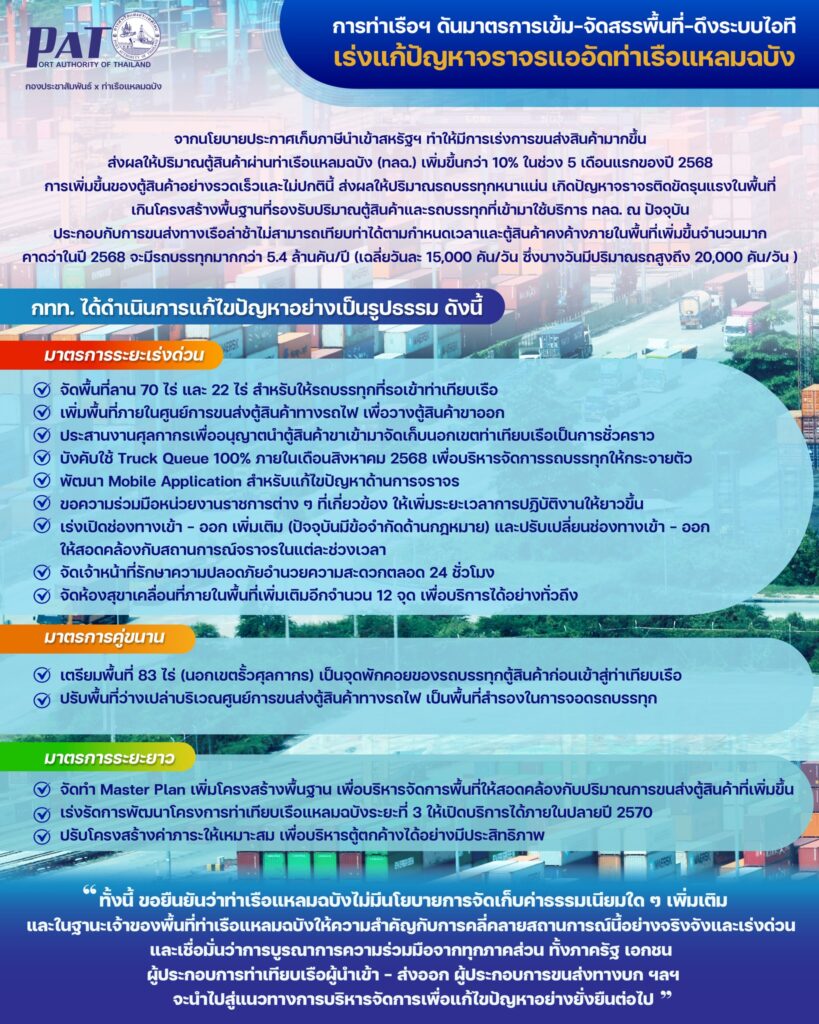
Laem Chabang Port Congestion: Urgent Fixes in Motion
Table of Contents
- Background: Surge in Container Volume
- Root Causes Behind the Congestion
- Urgent Measures to Ease the Gridlock
- Parallel Strategies Underway
- Long-Term Port Infrastructure Plans
- Public-Private Collaboration and Outlook
1. Background: Surge in Container Volume
The Laem Chabang Port congestion crisis has escalated in recent months due to a sharp increase in Thailand’s export and import activity, triggered by changes in U.S. import tariffs. As a result, the port has experienced a 10% surge in container traffic in just the first five months of 2025.
With over 5.4 million trucks expected to pass through the port by year-end—some days peaking at 20,000 trucks/day—the port’s existing infrastructure has reached critical strain, causing severe delays and truck lineups stretching beyond capacity.
2. Root Causes Behind the Congestion
Key issues behind the congestion include:
- Unprecedented increase in cargo volumes following U.S. trade policy shifts.
- Delayed berthing schedules, causing container backlog at terminals.
- Insufficient yard space and entry/exit capacity for trucks.
- Truck idle times exceeding 10+ hours, severely affecting fleet turnover and costs.
Port Authority data points to an urgent need for systemic changes, with some operators reporting financial losses of up to THB 200/hour per idle truck.
3. Urgent Measures to Ease the Gridlock
Led by Director Mr. Kriangkrai Chaiyasirivongsuk, the Port Authority of Thailand (PAT) has initiated a series of emergency responses to address the Laem Chabang Port congestion:
- ✅ Allocated 70-rai and 22-rai yards as temporary waiting zones for trucks.
- ✅ Expanded rail container yard capacity for export containers.
- ✅ Collaborated with Customs to store import containers outside port boundaries.
- ✅ Full enforcement of Truck Queue system by August 2025.
- ✅ Launch of a Mobile App for traffic and entry management.
- ✅ Request to extend operating hours among public-sector stakeholders.
- ✅ Rerouted and opened additional entry-exit lanes, subject to legal adjustment.
- ✅ Deployed 24/7 security personnel to coordinate traffic flow.
- ✅ Installed 12 additional mobile toilets to improve driver welfare.
4. Parallel Strategies Underway
In tandem, PAT is implementing parallel support measures, including:
- 🔄 Preparing an 83-rai off-port truck holding area outside customs zones.
- 🔄 Utilizing unused land near the rail terminal as overflow truck parking.
- 🔄 Establishing protocols for flexible container storage reallocation.
5. Long-Term Port Infrastructure Plans
To ensure sustainable resolution of Laem Chabang Port congestion, the following long-term strategies are being prioritized:
- 🛠️ Development of a Master Plan to enhance port infrastructure in alignment with projected cargo growth.
- 🏗️ Accelerating Phase 3 terminal development, with an expected launch by end of 2027.
- 💰 Revising storage fee structures to streamline clearance and reduce backlogs.
These strategies are designed to future-proof Thailand’s largest port, reinforcing its position as a leading logistics hub in Southeast Asia.
6. Public-Private Collaboration and Outlook
Director Kriangkrai reaffirmed that no additional fees or surcharges will be imposed during this crisis. PAT remains committed to urgently resolving the Laem Chabang Port congestion through transparent dialogue and proactive collaboration with:
- Government agencies
- Private port operators
- Inland transport providers
- Import/export businesses
The Port Authority’s coordinated approach reflects a serious, solutions-first mindset in restoring operational flow and minimizing economic disruptions.
“We believe that by working together across all sectors, we can manage the current crisis effectively and build a stronger foundation for the future of Thai logistics,” said Mr. Kriangkrai.
📎 Reference
Thank you: Port Authority of Thailand Facebook Update
